We build modern websites for service businesses and real estate teams that do more than look good. Capture more inquiries, guide visitors to act, and turn traffic into real opportunities.
Add AI chat, voice reception, and CRM follow-up so prospects get answers fast, appointments get booked, and your team spends less time chasing missed opportunities.
Connect your website, customer conversations, and follow-up workflows into one system that saves time, improves response speed, and helps you close more business across the GTA.
Better Customer Care for Local Businesses: Faster Follow-Up, Smarter Automation, More Booked Jobs
You can listen to this article here:
Better customer care is not just about being friendly. It is about helping customers feel looked after and helping business owners feel confident that no warm lead is being lost in the shuffle.
When a business follows up quickly, keeps conversations in one place, and automates the repetitive parts of communication, more inquiries turn into booked jobs and the day feels less reactive.
Customer Care That Feels Fast and Professional
Prospects notice when you reply quickly. They notice when you remember their last conversation. They notice when the process feels clear instead of chaotic.
That is why better customer care often starts with better systems. When calls, texts, forms, and follow-up all work together, your business feels more responsive, more trustworthy, and easier to choose.
Use Automation to Reduce Missed Opportunities
Automation helps local businesses respond when the team is busy, send reminders automatically, and keep new leads moving while work is happening on site.
That does not replace personal service. It supports it by making sure routine questions, lead capture, reminders, and early follow-up happen consistently, even on the busiest days.
Build a Better Follow-Up Process
Most businesses do not need more leads first. They need a better way to handle the leads they already get. A stronger follow-up process helps you stay organized, reduce delays, convert more opportunities into paying customers, and stop that sinking feeling that money is being left on the table.
Reputation Still Matters
Strong customer care leads to stronger reviews. When customers get quick answers, clear communication, and a smooth experience, they are more likely to trust your business, recommend it to others, and come back again.
Why This Matters for Local Businesses
For home service businesses and other local operators, speed matters. If a lead has to wait too long, the next company gets the call. Better customer care helps you protect the leads you already worked hard to earn and turn them into real revenue.
Ready to Improve Customer Care?
If your business is losing time to missed calls, slow follow-up, or scattered customer messages, Milton Ecom can help you build a better system for customer care, lead response, and practical automation so your business feels more organized and your customers feel better served.
Ready to improve follow-up? Call or text us at 1 (866) 259 3033 or book a strategy call to see where your customer care process can be tightened up so fewer opportunities slip away.
We work with local businesses across Milton, Hamilton, Toronto, and nearby communities that want faster follow-up, better customer care, and fewer missed opportunities.
If your business depends on calls, messages, estimates, appointments, and repeat customers, we can help you build a system that supports growth without adding more chaos.
Home service businesses in Canada, like plumbers, HVAC techs, electricians, and contractors, depend on a steady stream of quality leads to grow. But most run into the same roadblocks: missed calls, slow follow-ups, lost opportunities, and systems that do not talk to each other. These are real lead problems home services businesses deal with every day.
Good news: most of these issues are fixable with the right systems, process discipline, and team accountability. In this guide, we break down what is going wrong, how to set up a stronger home service lead generation engine, and the mistakes that quietly cost you booked jobs every month.
What This Means For Home Service Businesses
Here is what usually happens:
Potential customers call, but nobody answers.
Web form leads sit in inboxes too long.
Teams are too busy juggling jobs to follow up fast.
Opportunities get lost because there is no single pipeline.
The result is predictable: wasted ad spend, lower close rates, and avoidable revenue loss.
If you do not fix these lead problems, competitors who respond faster will keep winning work you already paid to attract.
Step-By-Step Setup To Fix Lead Problems
1. Capture Every Lead In One Place
Use a CRM built for service workflows. Every call, form, text, and DM should create a lead record automatically.
2. Make Speed-To-Lead Non-Negotiable
Fast response closes jobs. Add instant SMS/email acknowledgments and route new leads to the right rep immediately.
3. Stop Missing Calls
Set up call handling with forwarding, backup routing, or answering support. Missed calls are usually missed sales.
4. Systemize Follow-Up
Most leads do not convert on first contact. Build automated multi-touch follow-up across call, text, and email.
5. Track, Coach, Improve
Review pipeline metrics weekly. Train your team on scripts, response standards, and stage movement.
Common Mistakes To Avoid
Ignoring missed calls
Letting leads wait too long
Tracking jobs in scattered notes or inboxes
Following up once and giving up
Not tracking lead source quality
Avoid these and you will plug most leaks in your home service lead generation process.
How To Measure Results
Track these every week:
Speed-to-lead time
Call answer rate
Leads received vs jobs booked
Close rate by source
Follow-up completion rate
When these metrics improve, revenue stability improves.
FAQ
What is speed-to-lead?
It is how quickly your business responds to a new lead. Faster response typically increases conversion rate.
Do small teams really need a CRM?
Yes. Even small teams lose leads without centralized tracking and follow-up automation.
What if we cannot answer after-hours?
Use backup call handling plus automated acknowledgement so prospects know you received them and when they will hear back.
Ready To Fix Your Lead Leaks?
Stop letting high-intent leads slip through the cracks.
Visit https://miltonecom.com/contact-us/ to see how MiltonEcom helps home services businesses capture, follow up, close, and retain more customers.
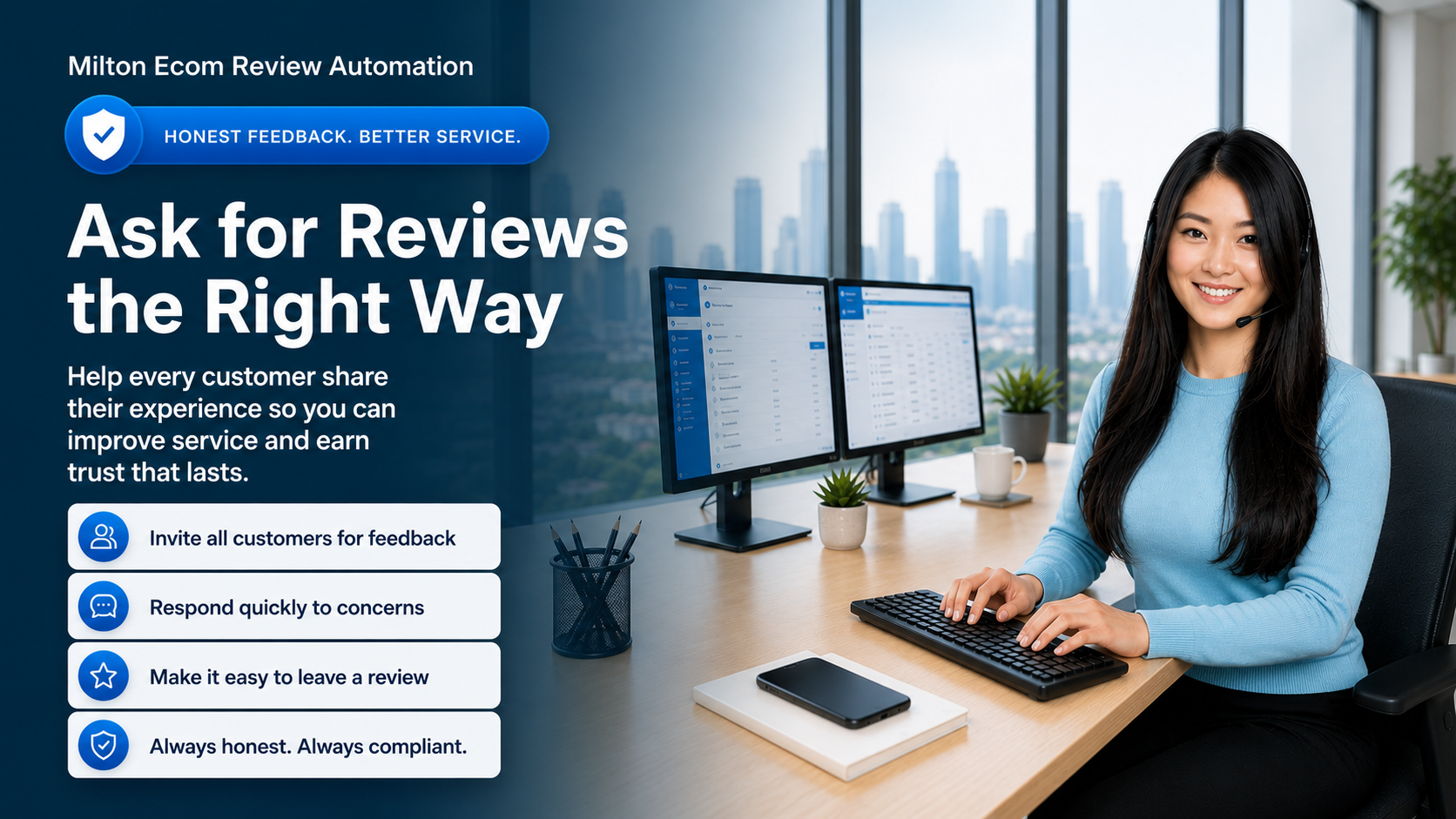
Customer follow-up, honest feedback, and compliant review requests help home service businesses protect trust after every completed job.
A bad review usually does not start on Google.
It starts earlier.
A late arrival. A rushed cleanup. A confusing invoice. A customer who felt ignored after the job was done.
Most home service companies only find out after the customer posts publicly. That is the problem.
The smarter move is to build a customer recovery system that checks in after every completed job, catches frustration early, alerts the office, and makes it easy for customers to share honest feedback.
For home services businesses, reviews do more than make the owner feel good. They create trust before a prospect ever picks up the phone. They reduce hesitation. They help the next customer feel safer inviting your company into their home.
But reputation is not just about asking for more reviews. It is about building a follow-up process that helps every customer feel heard after the work is done.
Why Customer Recovery Comes Before Review Growth
The Real Offer: A Reputation and Follow-Up System for Home Services
This is best understood as a reputation-protection and follow-up system for home services businesses, not as a simple review tool.
For a home services owner, the value is not just getting more review links out the door. The value is protecting trust after every completed job, spotting unhappy customers early, and giving the office a cleaner process for following up without adding more manual work.
The business gets:
automated review-request follow-up
customer satisfaction checks after completed jobs
SMS and email templates
alerts for the owner or office team when a customer is unhappy
follow-up and service-recovery workflow
reporting on responses, review clicks, and resolved issues
That matters because the value is broader than "sending review links." The real benefit is peace of mind, stronger trust in the local market, and a better chance to turn good service into visible proof.
Home service owners do not usually wake up thinking, "I need review automation."
They think:
"Why did that customer leave a bad review without calling us first?"
That is why the best review systems start with customer recovery.
After a completed job, a business should be able to:
ask every customer how the job went
give every customer a path to share feedback
make the public review process easy and professional
alert the owner or office when someone is unhappy
follow up quickly to recover the relationship
track responses, review clicks, and recovery outcomes
The goal is not just more stars. The goal is fewer surprises, better service recovery, stronger trust, and a more consistent customer experience.
What Happens Without a Review Follow-Up System
Without a clear process, review requests become random.
One technician asks. Another forgets. The office sends links when they remember. Unhappy customers get missed. Happy customers move on with their day.
The owner only notices when the public review profile starts slipping.
That is not a reputation strategy. That is reputation luck.
For a plumber, this could mean missing a customer who was unhappy about cleanup.
For an HVAC company, it could mean never finding out that the customer did not understand the thermostat setup.
For a cleaner, it could mean missing one room and hearing about it later in a neighborhood Facebook group.
For a landscaper, it could mean losing a seasonal customer because a scheduling issue was never followed up on.
The problem is not always the original mistake. The problem is that no system caught it soon enough.
What This Looks Like for a Home Services Business
This kind of workflow can be automated with simple response options, follow-up messages, and owner or office notifications.
Here is the basic workflow:
Step 1: Trigger the follow-up
The workflow starts after a completed job, paid invoice, completed appointment, or a simple manual step that marks the customer ready for follow-up.
Step 2: Ask how the experience went
Send an SMS or email asking:
"How was your experience with us today?"
Then give the customer a simple response path, such as a 1-to-5 rating or quick feedback buttons.
In a CRM or automation platform, this can be handled with trigger links, separate action buttons, or a short feedback form.
Step 3: Give every customer a clear path
Every customer should be able to share honest feedback. Every customer should also have access to the public review process.
The internal workflow can still help the business respond intelligently:
record the customer's response
send the appropriate follow-up message
make the public review link easy to access
alert the owner or office when the customer reports a problem
create a service recovery task when follow-up is needed
This is the key difference between a generic review request and a real reputation system. One sends a link. The other creates protection, responsiveness, and a better customer experience.
Step 4: Follow up quickly when something went wrong
When a customer reports a poor or mixed experience, the system should alert the right person quickly.
That may mean:
notifying the owner
creating a task for the office manager
sending a reply that acknowledges the concern
asking for details so the team can understand what happened
tracking whether the issue was resolved
Fast follow-up does not guarantee the customer will change how they feel, but it gives the business a chance to respond before the relationship is lost.
Why This Is Valuable for Home Services Businesses
For plumbers, HVAC companies, electricians, cleaners, landscapers, contractors, and other home services businesses, reviews directly affect trust and lead flow.
Customers often compare businesses quickly. A stronger review profile can mean more calls, more form submissions, and better close rates.
But reputation is not just about collecting stars. It is also about catching service issues before they turn into public frustration, bad word of mouth, or a lost future customer.
That is why this kind of workflow is useful:
customers get a consistent path to share feedback and access review options
unhappy customers get personal attention instead of being ignored
review requests become consistent instead of random
the office team gets a clear follow-up process
the business owner does not have to carry the stress of managing every request manually
Example SMS Flow
Customer check-in
Hi {{Name}}, thanks again for choosing {{Business}}. How was your experience with us today? Tap a number below or reply with any feedback.
1 | 2 | 3 | 4 | 5
If the customer responds with 4 or 5
Thank you, {{Name}}. We are glad you had a great experience and appreciate the feedback.
If the customer responds with 1 to 3
Thank you for letting us know, {{Name}}. We are sorry we missed the mark. A team member will review this right away. If you would like to share details now, just reply to this message.
Separate review request
Hi {{Name}}, thank you again for choosing {{Business}}. If you would like to leave an honest public review about your experience, you can do that here: {{ReviewLink}}
What to Track
If a business is going to keep investing in this kind of workflow, the owner should be able to see clear metrics.
Track:
how many follow-up requests were sent
how many customers responded
how many clicked the review link
how many customers reported a poor or mixed experience
how many recovery tasks were created
how many negative situations were resolved
which technicians, services, or job types need extra attention
That makes the system easier to justify month after month, not just as a one-time setup. It also helps the owner see whether the workflow is actively protecting revenue and reputation.
A Practical Note About Review Policies
Review platforms want honest feedback from real customers. This type of workflow should not be used to block, hide, discourage, delay, or filter negative reviews.
The safer and better long-term approach is to ask every customer for feedback, respond quickly when something went wrong, and keep public review access available on a consistent basis rather than routing only positive responses toward public platforms.
The goal is not to manipulate reviews. The goal is to improve service recovery, create a better follow-up process, and make it easier for customers to share honest experiences.
Why This Belongs in your Business
If you are reading this, you are probably not just looking for review advice. You are likely looking for a practical way to protect your reputation, improve follow-up, and make it easier for customers to speak up.
You may already be thinking about:
getting more Google reviews
protecting the brand
reducing manual follow-up
improving local SEO and trust
giving your office team a better follow-up process
That is why it makes sense to move from the idea to the actual solution. If you want this kind of workflow set up properly for your business, the next step is to look at the service options and see what fits your operation.
Related service:
Services: See how Milton Ecom helps local businesses improve follow-up, customer care, automation, and lead response.
Reputation Management: Explore how we help businesses strengthen trust, respond to reviews, and protect their online reputation.
CTA
Want this built into your CRM?
Milton Ecom helps home service businesses set up review follow-up, customer recovery alerts, SMS/email workflows, and reporting so completed jobs turn into stronger trust instead of missed opportunities.
The Ultimate Guide to Voice AI Receptionist for Small Business Owners
In today’s fast-paced business environment, every phone call counts. As a small business owner, you understand the importance of providing exceptional customer service and capturing valuable leads. This is where a Voice AI Receptionist comes into play.
Definition of Voice AI Receptionist
A Voice AI Receptionist is like having a virtual assistant for your phone system. It uses artificial intelligence to answer calls, interact with callers using natural language processing, qualify leads based on predefined criteria, and even take messages. Essentially, it streamlines your phone communication process by automating tasks that would typically require human intervention.
Why Voice AI Receptionist is Important for Business Owners
Having a Voice AI Receptionist can significantly benefit small business owners by enhancing customer experience, improving lead qualification, and optimizing call handling efficiency. By leveraging this technology, businesses can ensure that every call is answered promptly and professionally, leading to increased customer satisfaction and higher conversion rates.
Use Cases of Voice AI Receptionist
Lead Qualification: The Voice AI Receptionist can ask qualifying questions to callers based on predetermined criteria, allowing businesses to prioritize leads and allocate resources effectively.
Appointment Scheduling: Businesses can integrate their calendars with the Voice AI Receptionist to allow callers to schedule appointments seamlessly without human intervention.
Customer Support: The Voice AI Receptionist can handle common customer queries, provide basic information, and route calls to the appropriate department, reducing wait times and improving customer service.
FAQs about Voice AI Receptionist
1. How does Voice AI Receptionist handle multiple calls simultaneously?
The Voice AI Receptionist utilizes advanced call routing algorithms to manage multiple calls efficiently. It can prioritize calls based on predefined criteria and handle them simultaneously without compromising the quality of service.
2. Can Voice AI Receptionist adapt to different accents and dialects?
Yes, Voice AI Receptionist is equipped with sophisticated natural language processing capabilities that enable it to understand and respond to a wide range of accents and dialects, ensuring seamless communication with callers.
3. Is Voice AI Receptionist customizable to suit specific business needs?
Absolutely! Businesses can customize the Voice AI Receptionist’s scripts, responses, and call handling protocols to align with their unique requirements, ensuring a tailored experience for callers.
Metaphors to Explain Voice AI Receptionist
Voice AI Receptionist as Your Virtual Front Desk: Just like a receptionist at your physical office greets visitors, answers queries, and directs them to the right department, a Voice AI Receptionist performs similar tasks for your phone calls in a digital environment.
Voice AI Receptionist as Your Personal Assistant: Think of the Voice AI Receptionist as your trusty assistant who handles all your phone-related tasks with precision and efficiency, allowing you to focus on other aspects of your business.
For more information on Voice AI Receptionist and related terms, visit our Glossary.
In conclusion, integrating a Voice AI Receptionist into your business communication system can revolutionize the way you handle phone calls, streamline operations, and enhance customer interactions. Embrace this cutting-edge technology to stay ahead of the competition and provide exceptional service to your customers.
Wondering if an AI Voice Agent is the perfect solution for your needs?
Struggling to keep up with calls, texts, and missed leads?
An AI Voice Agent doesn’t sleep, doesn’t miss calls, and doesn’t get overwhelmed. It just performs.
We’ll build and launch a custom AI Voice Agent for your business — trained on your brand, tone, and offers — so you can capture leads 24/7 and close more without lifting a finger.
1. How does Voice AI Receptionist handle multiple calls simultaneously?
The Voice AI Receptionist utilizes advanced call routing algorithms to manage multiple calls efficiently. It can prioritize calls based on predefined criteria and handle them simultaneously without compromising the quality of service.
2. Can Voice AI Receptionist adapt to different accents and dialects?
Yes, Voice AI Receptionist is equipped with sophisticated natural language processing capabilities that enable it to understand and respond to a wide range of accents and dialects, ensuring seamless communication with callers.
3. Is Voice AI Receptionist customizable to suit specific business needs?
Absolutely! Businesses can customize the Voice AI Receptionist’s scripts, responses, and call handling protocols to align with their unique requirements, ensuring a tailored experience for callers.
The Ultimate Guide to Voice AI Receptionist for Small Business Owners
In today’s fast-paced business environment, every phone call counts. As a small business owner, you understand the importance of providing exceptional customer service and capturing valuable leads. This is where a Voice AI Receptionist comes into play.
Definition of Voice AI Receptionist
A Voice AI Receptionist is like having a virtual assistant for your phone system. It uses artificial intelligence to answer calls, interact with callers using natural language processing, qualify leads based on predefined criteria, and even take messages. Essentially, it streamlines your phone communication process by automating tasks that would typically require human intervention.
Why Voice AI Receptionist is Important for Business Owners
Having a Voice AI Receptionist can significantly benefit small business owners by enhancing customer experience, improving lead qualification, and optimizing call handling efficiency. By leveraging this technology, businesses can ensure that every call is answered promptly and professionally, leading to increased customer satisfaction and higher conversion rates.
Use Cases of Voice AI Receptionist
Lead Qualification: The Voice AI Receptionist can ask qualifying questions to callers based on predetermined criteria, allowing businesses to prioritize leads and allocate resources effectively.
Appointment Scheduling: Businesses can integrate their calendars with the Voice AI Receptionist to allow callers to schedule appointments seamlessly without human intervention.
Customer Support: The Voice AI Receptionist can handle common customer queries, provide basic information, and route calls to the appropriate department, reducing wait times and improving customer service.
FAQs about Voice AI Receptionist
1. How does Voice AI Receptionist handle multiple calls simultaneously?
The Voice AI Receptionist utilizes advanced call routing algorithms to manage multiple calls efficiently. It can prioritize calls based on predefined criteria and handle them simultaneously without compromising the quality of service.
2. Can Voice AI Receptionist adapt to different accents and dialects?
Yes, Voice AI Receptionist is equipped with sophisticated natural language processing capabilities that enable it to understand and respond to a wide range of accents and dialects, ensuring seamless communication with callers.
3. Is Voice AI Receptionist customizable to suit specific business needs?
Absolutely! Businesses can customize the Voice AI Receptionist’s scripts, responses, and call handling protocols to align with their unique requirements, ensuring a tailored experience for callers.
Metaphors to Explain Voice AI Receptionist
Voice AI Receptionist as Your Virtual Front Desk: Just like a receptionist at your physical office greets visitors, answers queries, and directs them to the right department, a Voice AI Receptionist performs similar tasks for your phone calls in a digital environment.
Voice AI Receptionist as Your Personal Assistant: Think of the Voice AI Receptionist as your trusty assistant who handles all your phone-related tasks with precision and efficiency, allowing you to focus on other aspects of your business.
For more information on Voice AI Receptionist and related terms, visit our Glossary.
In conclusion, integrating a Voice AI Receptionist into your business communication system can revolutionize the way you handle phone calls, streamline operations, and enhance customer interactions. Embrace this cutting-edge technology to stay ahead of the competition and provide exceptional service to your customers.
A Beginner’s Guide to No-Code AI Development with MindStudio
Artificial intelligence has moved from hype to hands-on. You no longer need to be a developer, data scientist, or machine learning wizard to create powerful AI tools. Thanks to platforms like MindStudio, building custom AI agents is now as simple as drag, drop, and deploy.
This guide walks you through building your first AI agent from scratch using MindStudio. Whether you’re a business owner, a curious beginner, or a no-code enthusiast, this step-by-step tutorial will show you how to create smart, scalable solutions in minutes.
And if you’d rather have it done for you? MiltonEcom can build your AI agents, tailored to your business needs.
What is an AI Agent?
An AI agent is a self-directed digital assistant that processes data, makes decisions, and acts in real-time. It receives input (like text from a webpage or a document), applies logic using AI models, and delivers a response or action—all without your constant oversight.
Use cases include:
Automating content summaries
Analyzing customer feedback
Parsing complex documents
Handling support inquiries
AI agents are already transforming how businesses work. Now it’s your turn.
Why MindStudio?
MindStudio is a no-code AI platform designed for everyday users. It combines a visual workflow builder with support for over 90 cutting-edge AI models, including OpenAI, Anthropic, and Google’s Gemini.
Key features:
Visual drag-and-drop builder
Browser extension integration
AI prompt generator
Real-time testing
No coding required
Whether you’re building a chatbot, a content summarizer, or a financial analyzer, MindStudio makes the process fast, simple, and scalable.
Open the Build tab to access the visual workflow editor.
2. Configure the Workflow
Click the Start block and change the run mode to “Browser Extension.”
This enables your agent to access live webpage content like metadata and full text.
3. Add an AI Model
Drag in a Generate Text block.
Choose a model like Gemini 1.5 Flash or Claude 3.5 Haiku.
Use this prompt:
Summarize this content clearly and concisely: {{pageContent}}
The variable {{pageContent}} will pull in content from the webpage or PDF.
4. Test and Deploy
Name your agent (e.g., “Content Summarizer”).
Click Publish.
Pin the MindStudio extension to your browser. You’re now ready to summarize content with one click.
More Use Cases to Explore
Once you’re comfortable with the basics, try building AI agents for:
Social Media Analysis
Analyze Twitter (X) threads to extract sentiment, engagement patterns, and trending themes.
Financial Document Review
Parse complex 10-Q filings to extract key metrics like revenue, net income, and risk factors—automatically.
Lead Qualification
Build a chatbot-style agent to screen inquiries, qualify leads, and feed data into your CRM.
Best Practices for Better AI Agents
Prompt Engineering
Write clear, outcome-focused prompts.
Use MindStudio’s prompt generator to improve performance.
Workflow Customization
Duplicate and modify existing agents.
Adjust prompts and response parameters for each use case.
Scaling Up
Add additional blocks to chain tasks.
Create multi-step workflows with conditional logic.
Real-World Examples
Content Teams Summarize blog posts, YouTube transcripts, and long-form reports for faster content production.
Small Businesses Automate FAQs, customer responses, and lead processing without hiring extra help.
Professionals Turn dense reports into key takeaways, saving time and improving decision-making.
What is an AI Agent?
An AI agent is a self-directed digital assistant that processes data, makes decisions, and acts in real-time. It receives input (like text from a webpage or a document), applies logic using AI models, and delivers a response or action—all without your constant oversight.
Use cases include:
Automating content summaries
Analyzing customer feedback
Parsing complex documents
Handling support inquiries
AI agents are already transforming how businesses work. Now it’s your turn.
What’s Next for MindStudio?
MindStudio continues to evolve with features like:
Workflow branching and conditional logic
App integrations (CRMs, Zapier, Slack)
Custom code injection for advanced users
It’s a growing platform with serious potential for creators, entrepreneurs, and teams.
Prefer Done-for-You?
You don’t have to figure this all out alone. MiltonEcom can design, build, and deploy AI agents customized for your business goals.
Whether you’re in eCommerce, home services, or any high-volume industry, we’ll help you automate smarter—not harder.
Need a summarizer, analyzer, lead-qualifier, or content generator? We’ve got you.
Contact MiltonEcom to request a custom AI agent built just for your business.
Final Thoughts
AI isn’t the future—it’s the new normal. With MindStudio, you can start building tools that automate work, uncover insights, and save time starting today.
Ready to get your own AI agent built and deployed fast? Contact MiltonEcom and let’s bring your automation idea to life.
Many local business owners still manage leads with a mix of memory, sticky notes, missed texts, and whatever they can find in the moment. It works until it does not.
One missed callback turns into a lost estimate. One forgotten message turns into a cold lead. One delayed reply sends a prospect to the next company on Google.
The problem is not effort. The problem is the lack of a system. When follow-up depends on memory, good opportunities disappear quietly.
What Is a CRM?
A CRM is a customer relationship management system. In plain language, it is the place where your customer conversations, lead details, follow-ups, appointments, and sales activity stay organized.
Instead of juggling messages across forms, calls, texts, email, and social media, a CRM helps your business keep the full conversation in one place. That makes it easier to respond quickly, see what needs attention, and make sure no lead gets ignored.
Why Local Businesses Lose Leads Without One
Most businesses do not lose leads because they lack demand. They lose them because response time slips, details get buried, and follow-up happens too late.
Without a reliable system, it is easy to miss a voicemail, forget to send a quote, overlook a web form, or leave a prospect waiting while the day gets busy. The longer the delay, the more likely that customer chooses someone else.
A CRM gives your team a single place to see who reached out, what they need, and what should happen next.
The Real Value: Better Customer Care at Scale
The biggest benefit of a CRM is not just organization. It is better customer care.
When your system is set up properly, you can reply faster, send timely reminders, track open opportunities, and keep communication moving even when your team is busy. Customers feel looked after. Your team feels less scattered. More leads make it from first inquiry to booked job.
That is what better systems do: they reduce friction for both your business and the customer.
A Simple Example
Imagine a busy service business on a weekday afternoon. Calls come in while the team is on site. A web form arrives. Two text messages need replies. Someone asks for a quote. Another customer needs a reminder.
Without a system, that work gets split across phones, inboxes, and memory. With a CRM, each inquiry is captured, assigned, and followed up in a consistent way. The business responds faster, misses fewer opportunities, and looks more professional in the process.
What a Good CRM Helps You Do
A good CRM helps your business:
track new leads in one place
keep calls, texts, forms, and email organized
follow up faster and more consistently
send reminders and nurture messages automatically
see which opportunities are active and which need attention
improve customer care without adding more manual work
If your business depends on inquiries, callbacks, appointments, and repeat customers, a CRM is not a luxury. It is part of how you stay responsive and competitive.
Get the Free Infographic: 6 Ways a CRM Improves Customer Care and Follow-Up
The Hudson’s Bay Company (HBC), founded on May 2, 1670, in London, United Kingdom, was once a titan of global commerce. From its dominance in the fur trade to its role as a leading Canadian retailer, HBC boasts a legacy spanning over 350 years. Yet, as of March 2025, the company teeters on the edge of oblivion. Just weeks ago, it reportedly had a mere $3 million in cash reserves, burdened by a crushing $1 billion in debt. With only 80 stores left across Canada—a sharp decline from its peak—HBC’s impending liquidation by June 15, 2025, raises pressing questions: What went wrong? And could it have been saved?
The answer is yes—but only if HBC had embraced e-commerce far earlier and reimagined its vast network of physical stores.
The Missed E-Commerce Opportunity
The retail landscape began shifting dramatically in the early 2000s, with pioneers like Amazon redefining shopping through e-commerce. Traditional giants like Walmart and Target adapted swiftly, pouring resources into digital platforms and logistics. HBC, however, clung to its brick-and-mortar roots for too long. By the time it took e-commerce seriously, the company was lagging behind, unable to recapture consumers who had flocked to more agile, customer-focused online retailers. With its storied brand and loyal customer base, HBC had a golden opportunity to create a premium online marketplace—but it failed to seize it.
What HBC Could Have Done with Its Stores
Had HBC pivoted to e-commerce sooner, its 80+ locations could have become strategic assets rather than financial burdens. Here’s how:
Micro-Fulfillment Centers
By converting stores into micro-fulfillment hubs, HBC could have offered same-day or next-day delivery, rivaling Amazon’s Prime model while maintaining a localized, efficient supply chain.
Omnichannel Shopping Experience
A seamless blend of online and in-store shopping—such as “buy online, pick up in-store” (BOPIS) and hassle-free returns—could have appealed to both digital-savvy and traditional shoppers.
Experiential Retail Spaces
Rather than focusing solely on sales, stores could have been reimagined as immersive destinations, offering curated brand experiences, fashion events, and personalized services that e-commerce can’t replicate.
HBC could have taken cues from Bernard Arnault, the world’s richest man and architect of the LVMH luxury empire. By introducing premium sections in flagship stores—think high-end purses ($10,000) and suits ($50,000), served with champagne—HBC could have positioned itself as a luxury destination akin to Fifth Avenue boutiques, shedding its mid-tier department store image.
Who Is Bernard Arnault?
Bernard Arnault
Role: Chairman and CEO of LVMH (Moët Hennessy Louis Vuitton), the world’s largest luxury goods conglomerate.
Founded: Arnault entered the luxury sector in 1984 by acquiring a majority stake in LVMH, later expanding it with brands like Louis Vuitton, Dior, Givenchy, and Fendi.
Number of Stores: LVMH operates over 5,600 stores worldwide, delivering bespoke shopping experiences.
Luxury Experience: LVMH stores offer exclusivity—personalized service, private fittings, champagne, and a refined ambiance—setting the benchmark for high-end retail.
Subscription-Based Shopping & Loyalty Programs
A loyalty program akin to Amazon Prime, offering exclusive perks, early sale access, and free shipping, could have driven recurring revenue and customer retention.
Private Label & Direct-to-Consumer Expansion
By developing its own private-label brands—exclusive to its platform—HBC could have boosted margins and carved out a unique market niche.
The Lesson for Other Legacy Retailers
HBC’s downfall is a stark warning for legacy retailers resisting digital transformation. E-commerce isn’t just about launching a website; it’s about rethinking operations, from supply chains to customer engagement. Had HBC acted decisively, it might have thrived in today’s retail landscape rather than facing collapse. Its brand still carries cultural weight, but without a radical overhaul, it risks fading into history.
For retailers still in the game: adapt now, or become the next cautionary tale.
Dear Reader, Is Your Retail Store Future-Proof?
If you own a retail business and want to sidestep HBC’s fate, now is the time to embrace e-commerce. Whether you’re expanding online, enhancing your digital presence, or building an omnichannel experience, MiltonEcom.com can help. Contact MiltonEcom.com today to secure your place in the digital economy.
FAQ: Hudson’s Bay Company’s Liquidation and Zellers Relaunch
Why is Hudson’s Bay Company liquidating all its stores?
HBC filed for bankruptcy, citing insurmountable debt, operational inefficiencies, and failure to compete in the digital age, with plans to close all stores by June 2025.
What will happen to the Zellers pop-up shops within Hudson’s Bay stores?
The Zellers relaunch from 2023 will end as all Hudson’s Bay locations shut down.
What led to HBC’s failure?
Key factors include delayed e-commerce adoption, reliance on an outdated retail model, and financial mismanagement resulting in excessive debt.
Could Hudson’s Bay or Zellers be revived?
Revival is possible but would demand significant capital, a fresh strategy, and a complete business model rethink.
How can other retailers avoid this fate?
Prioritize digital transformation, integrate e-commerce with physical stores, and craft compelling omnichannel experiences. Companies like MiltonEcom.com specialize in guiding retailers through this shift.
Is Your Small Business Stuck in the Game of Thrones Era? Fix It Now!
Imagine you’re running a kingdom in Game of Thrones—but instead of dragons and swords, you’re a home service provider fighting for customers in today’s digital battlefield. You’re relying on outdated tools, word-of-mouth referrals, and a scattered approach to customer communication.
It’s like trying to defend a castle with wooden shields while your competitors have discovered gunpowder.
The businesses that survive and thrive aren’t the ones stuck in medieval times. They’re the ones that adapt, automate, and dominate. And the difference?
A quality CRM, a smart website, and an AI Smart Phone Number.
The Digital “Game of Thrones”: Why Some Businesses Get Left Behind
Much like the world of Westeros, small businesses without the right tools are doomed to repeat the cycle of struggle, stagnation, and missed opportunities. Here’s why:
1. No CRM? You’re Fighting with Swords While Others Have Cannons
In the world of home services, most businesses still rely on manual scheduling, scattered customer notes, and chasing down leads one by one.
This is the equivalent of a medieval king sending a messenger on horseback instead of using a smart CRM that automates follow-ups, schedules jobs, and nurtures leads.
With a CRM: Every inquiry, customer interaction, and job request is tracked, organized, and optimized.
Without a CRM: You’re scrambling to remember customer names, missing follow-ups, and losing jobs to faster competitors.
2. A Weak Website? You Might as Well Be Sending Ravens
In Game of Thrones, messages were sent via ravens—slow, unreliable, and often intercepted.
Now, imagine your website is that raven. If it’s outdated, slow, or not designed to capture leads, it’s as useless as a burned letter in a war zone.
With a Smart Website: Customers can book instantly, get answers 24/7, and feel confident in your business.
Without It: Your leads disappear like a message lost in the wind.
3. No AI Smart Phone Number? You’re Ignoring Customers Like a Lazy King
If someone texts or calls your business and gets no response, they move on. Just like a neglected kingdom falls into ruin, a business without instant responses loses trust—and money.
An AI Smart Phone Number acts as your Hand of the King, ensuring every call or text is answered, inquiries are handled instantly, and appointments are scheduled without you lifting a finger.
With an AI Smart Phone Number: Leads are captured 24/7, customers feel valued, and your business runs without manual effort.
Without It: You lose jobs to competitors who answer first.
The Final Battle: Do You Want to Conquer or Be Forgotten?
The world of Game of Thrones shows what happens when kingdoms fail to evolve—they get conquered.
Right now, businesses that refuse to modernize are being left behind while those embracing automation, AI, and smart CRM systems are pulling ahead.
If you’re still relying on outdated methods, you’re stuck in the medieval age.
But it doesn’t have to be that way.
At Milton Ecom, we help home service providers step into the future with:
✅ A CRM that automates your customer interactions ✅ A smart website that turns visitors into paying clients ✅ An AI Smart Phone Number that captures leads and books jobs instantly
The choice is simple:Adapt and dominate, or stay stuck in the past.
Call or text 1 866 259 3033 to future-proof your business today.
For small business owners, especially in the home services sector, modernizing operations can feel daunting. However, miltonecom.com provides digital solutions to help streamline processes and stay competitive. Below, we’ve compiled FAQs to clarify how our services can benefit your business, based on the content of this page “Is Your Small Business Stuck in the Game of Thrones Era? Fix It Now!” These questions address common concerns and provide practical insights for getting started.
The World (the Known World) of Game of Thrones is set on Earth. A fictional future Post Apocalyptic Earth. Perhaps long after a nuclear war (with lasting consequences, plate tectonics and the like) with forgotten technologies yet to be rediscovered and with new technologies active in use and confused with magic.
Here are some reasons why:
Familiar Foods: Clues of Earth’s Continuity
The existence of Earth-like crops and culinary practices (e.g., pies, bread, ale, wine, rum) strongly suggests that this isn’t an alien world.
The lack of new agricultural products (no alien fruits, grains, or spices) points to agricultural continuity from Earth’s historical crops.
Viticulture (wine-making) and distillation (rum) require advanced agricultural knowledge—suggesting that humanity retained cultural memories of these processes after a collapse.
If Game of Thrones were truly another planet or dimension, we’d expect different evolutionary paths for flora and culinary staples. The preservation of Earth’s diet implies that this is Earth, after civilization reset itself.
Identical Trees: Evolutionary Fingerprints
The presence of recognizable trees like willows, beech, cedars, and pines—all of which are Earth-specific species—is another biological fingerprint of Earth.
These species evolved thousands of years ago under Earth’s specific environmental conditions. Their presence means:
Either Earth’s biosphere survived catastrophic events.
Or humanity replanted these species after a collapse using preserved genetic material—consistent with post-apocalyptic terraforming efforts.
If the planet had been terraformed by survivors from our era, they would have chosen familiar species to restore ecosystems. The uniformity of these tree species across continents also hints at artificial rewilding efforts.
Weirwoods: A Bio-Internet for a Post-EMP World
The weirwoods, with their face carvings, blood-red sap, and telepathic properties, might represent a biological neural network—a bio-internet that transmits and stores human thought patterns.
Consider the following:
Greenseers (like Bran Stark) can access memories and visions through the weirwoods. This could represent neural interfacing with a biological data-storage system.
The Children of the Forest might have engineered the weirwoods to act as organic data servers, capable of broadcasting frequencies only certain genetically receptive humans (like Bran) can perceive.
Telepathic Communication: In a world without electronics (due to EMP damage), biological frequencies transmitted by trees might have been an alternative communication system—Earth’s fallback internet, based entirely on organic neural networks.
Why a Bio-Internet?
After a nuclear holocaust, global EMP (Electromagnetic Pulse) damage would fry electronics, satellites, and communication systems.
With no ability to store or transmit data electronically, genetically engineered flora could have been humanity’s solution—a living internet, storing memories, history, and knowledge in DNA-coded sap.
The carved faces in weirwoods could represent access points—interfaces where ancient people uploaded consciousness or memories, now accessible to those with Greenseer genes.
EMP Damage and Medieval Stagnation
The stagnation in technology for thousands of years—a major puzzle in Game of Thrones—is perfectly explained by widespread EMP devastation:
No working electronics, no metalworking at advanced levels (beyond what can be rediscovered through trial and error), and no new innovations because key scientific knowledge was lost.
This would force humanity back into medieval technologies: swords, castles, and animal-powered transportation.
The knowledge of gunpowder, electricity, or advanced machinery would fade into myth, remembered only as “magic.”
Valyrian Steel as Pre-War Tech:
Valyrian steel could represent lost metallurgy techniques—perhaps nanostructured alloys or self-healing materials produced by pre-holocaust civilizations.
Its indestructibility and unique sharpness could be explained by nanotechnology that modern societies no longer understand—a material immune to EMP damage because it’s entirely atomic-level engineered.
Dragons as Genetic Experiments
Dragons could have been genetically resurrected or engineered from dinosaur DNA, perhaps modified for use as bio-weapons.
The Targaryen bloodline may have carried genetic markers enabling them to psychically bond with dragons—another pre-apocalypse technology that was reduced to myth and prophecy after civilization fell.
The Long Night as Nuclear Winter
The Long Night, a generation-long winter that almost wiped out humanity, could be explained by a nuclear winter following a global thermonuclear war:
Ash and debris in the atmosphere blocking sunlight.
Global crop failures and mass extinctions.
Societies collapsing into feudal warlords, with oral traditions preserving distorted memories of the apocalypse.
The White Walkers as a Children of the Forest Bio Hacking mistake. It warns of the danger of letting technology make technology like AI’s making AIs unsupervised on not fully understood.
Men made the “Children of the Forest” (Guardians of Nature) and they overwrote human DNA to make White Walkers. Humanity engineered the White Walkers indireclty and the effect was to regulate life to a crisis degree. This shows the importance of making sure that our technology, even AI is checked and verified to always be in the service of mankind.
The Role of the Three-Eyed Raven
The Three-Eyed Raven, as a being capable of seeing through time, might represent the last remnant of pre-holocaust consciousness—someone who successfully uploaded their mind into the weirwood network, functioning as a watcher over humanity’s attempts to rebuild.
Bran Stark, by inheriting this role, represents humanity’s final opportunity to break the cycle of destruction—armed with knowledge from both the past (pre-apocalypse) and the present (post-collapse world).
Sociocultural Resilience: Why History Repeats Itself
The persistence of monarchies, religion, and tribal politics shows that human social structures regressed to familiar patterns after the collapse.
Religious groups like the Faith of the Seven and R’hllor’s followers might represent distorted remnants of pre-collapse ideologies, surviving in oral traditions and half-remembered rituals.
The “Song of Ice and Fire”: Restoring Balance
In this post-EMP, post-nuclear world, the Song of Ice and Fire might represent the synthesis of bioengineered forces (the cold, calculated White Walkers) with the uncontrollable power of dragons (fire).
The “song” itself could be a genetic code, a final algorithm or sequence necessary to restore climate balance and reboot the ecosystem without triggering another cycle of destruction.
Conclusion: The World of Westeros as a Post-Nuclear Earth
This theory perfectly weaves together:
Genetic tampering (Children of the Forest, White Walkers, Targaryens)
Biological networks (weirwoods as bio-internet)
Technological stagnation explained by EMP fallout
Ecological continuity (familiar flora and fauna)
Culinary traditions (pies, rum, wine) that survived cultural collapse
Nuclear winter explaining the Long Night
Valyrian steel as indestructible nanomaterial from a lost technological age
In this scenario, humanity is Earth’s final experiment, trying again and again to rebuild after self-destruction, with the weirwoods as organic memory banks and genetic mistakes like the White Walkers (and (AI/Robotic) Children of the Forest) mistake threatening regrowth.
Game of Thrones might not just be a fantasy epic, but a warning: a vision of Earth’s distant future, where bioengineering, nuclear war, and EMP devastation have forced humanity back into the Middle Ages, fighting over the scraps of a forgotten golden age they no longer understand.
In the end, the “Song of Ice and Fire” could be humanity’s final attempt to reconcile fire (technology, ambition, growth) with ice (control, stability, preservation)—a last chance to break the cycle of rise, ruin, and rebirth on a scarred Earth that has seen it all before.
Afterall, its only fantasy. It’s only entertainment. But we can learn lessons from some of it’s themes.
What is a CRM, and How Can It Help My Home Service Business?
A Customer Relationship Management (CRM) system is a tool that helps manage interactions with customers, from initial inquiries to job completion and follow-up. For home service businesses, it can automate scheduling, track customer preferences, and provide insights for better service delivery. This leads to improved efficiency, better customer service, and increased customer loyalty.
What Makes a Website "Smart," and Why Is It Important for My Business?
A smart website is designed to be interactive and user-friendly, allowing customers to book services instantly, get real-time updates, and engage with the business 24/7. This helps in increasing customer satisfaction and operational efficiency by providing a seamless and convenient experience for customers, which is crucial for staying competitive in today’s market.
How Does an AI Smart Phone Number Work, and What Advantages Does It Offer?
An AI Smart Phone Number uses artificial intelligence to handle incoming calls, capture leads, and provide instant responses. It can greet callers, answer frequently asked questions, and even schedule appointments, ensuring that no lead is missed, even outside business hours. This improves customer service and lead conversion rates, helping you never miss a potential customer.
How Can These Digital Tools Help Me Compete with Larger Companies in My Industry?
Larger companies often have the resources to invest in advanced technology, giving them an edge in customer service and operational efficiency. By using tools like CRM, a smart website, and an AI Smart Phone Number, small businesses can level the playing field by offering similar levels of service and automation, thereby competing more effectively and attracting more customers.
What Is the Expected Return on Investment (ROI) from Implementing These Digital Tools?
While specific ROIs (return on investment) can vary, businesses typically see improvements in customer acquisition, retention, and operational efficiency, leading to increased revenue and reduced costs over time. The exact return depends on how well the tools are implemented and utilized, but the evidence leans toward significant long-term benefits for small businesses.
Do I Need Technical Expertise to Use These Tools?
No, the tools are designed to be user-friendly, and miltonecom.com provides comprehensive training and support to ensure that you and your team can use them effectively. Minimal technical expertise is required, making it accessible for small business owners without a tech background.
What Security Measures Are in Place to Protect Customer Data?
We take data security very seriously. The systems are equipped with the latest security protocols, including encryption and regular auditing, to ensure that customer data is protected at all times. This is crucial for maintaining trust and complying with data protection regulations.
What Is the Process for Getting Started with miltonecom.com's Services?
To get started, simply contact us at 1 866 259 3033 to schedule a consultation. During the consultation, we’ll discuss your business needs and tailor a solution that fits your requirements. From there, we’ll handle the setup and provide training to get you up and running, ensuring a smooth transition.
How AI-Powered Business Automation Can Double Your Productivity (Without Doubling Your Workload)
You can listen to this artile here:
Introduction: The Story of John
John was overwhelmed. Running his own landscaping business meant early mornings, long days, and endless paperwork at night. He spent hours responding to customer inquiries, scheduling appointments, following up on leads, and handling invoices. His work was top-notch, but he was losing jobs simply because he couldn’t keep up with the admin side of things.
Then, he discovered AI-powered business automation—and everything changed.
Now, John’s chatbot answers customer questions 24/7, automated reminders ensure clients never miss an appointment, and his scheduling software books jobs while he’s out on site. Instead of drowning in paperwork, John is focused on growing his business and delivering great service.
Does this sound familiar? If so, keep reading.
The Hidden Costs of Manual Work
Imagine a carpenter using a dull handsaw instead of a power saw. Sure, he gets the job done, but he spends twice the time and effort. The same thing happens when businesses rely on manual processes instead of automation.
Home service providers waste countless hours every week on repetitive tasks:
✅ Manually responding to emails and customer inquiries
✅ Scheduling appointments and sending reminders
✅ Following up with leads who never respond
✅ Posting on social media without a strategy
✅ Handling invoices and payments manually
These tasks eat away at your most valuable resource: your time. And time is money.
What is Business Automation and Why Does It Matter?
Business automation uses AI and software to handle repetitive processes so you don’t have to. It takes care of the busywork, giving you time to focus on growing your business.
Some of the best ways to automate your business include: 🚀 AI Chatbots that answer customer questions instantly (without hiring extra staff)
📅 Appointment Scheduling Software that books clients for you
📧 Automated Email & SMS Follow-Ups to convert more leads
⭐ Reputation Management that collects 5-star reviews on autopilot
📞 AI Smart Phone Number that instantly responds to inquiries via text
Jake, a local bakery owner, thought he needed to hire another employee just to handle customer orders and inquiries. Instead, he set up an AI chatbot on his website and automated his appointment bookings. Customers got instant answers, and orders increased by 30%—without him hiring anyone.
Mike, an electrician, was losing potential clients because he couldn’t answer calls while working on job sites. He set up an AI-powered chatbot that collected customer details and scheduled consultations. Within a month, he landed $20,000 in new jobs—while he was busy working.
Ready to Automate? Let’s Get Started
How many hours a week are you losing to repetitive tasks? Imagine what you could accomplish if you got that time back.
It’s time to automate and grow.
📞 Call or text 1 866 259 3033 to learn how we can streamline your business. 📅 Book a Free Strategy Call and take the first step toward automation.
You don’t need to work harder. You need smarter automation—and we can help.
A CRM (Customer Relationship Management) system helps you organize and track customer interactions, leads, and sales. Think of it as a digital assistant that keeps track of all your clients and makes sure no leads slip through the cracks.
What is an AI Chatbot?
An AI Chatbot is an automated virtual assistant that can answer customer questions, book appointments, and even handle sales inquiries—all without human intervention. It works 24/7, ensuring you never miss a lead.
How can automation help my home services business?
Automation helps by handling scheduling, follow-ups, and customer communication. For example, a plumbing business can use AI to book jobs, send reminders, and request reviews—freeing up time to focus on actual work.
Is automation expensive?
Not at all! Many automation tools are affordable and save you money by reducing missed appointments, lost leads, and administrative overhead.
How do I get started?
Simply call or text 1 866 259 3033 or book a free strategy call. We’ll analyze your business needs and recommend the best automation tools to help you grow.
Looking for Business Automation in Hamilton?
If you’re a home service provider in Hamilton, Hamilton Ecom offers tailored automation solutions to help you streamline your operations, generate more leads, and improve customer satisfaction. Discover how AI-driven tools can revolutionize your business today!
Why Hamilton Businesses Need Professional Website Design:
A Comprehensive Guide
Why Hamilton Businesses Need a Pro Website Design:
Full Guide
Listen to our Hamilton Website Design audio presentation
Introduction:
In today’s digital age, having a well-designed website is crucial for any business looking to succeed—especially in Hamilton. Whether you’re a local entrepreneur, a real estate agent, or an HVAC provider, your website is often the first point of contact with potential customers. In this article, we’ll explore the importance of professional website design and how it can help your Hamilton-based business grow.
1. Why Website Design Matters for Hamilton Businesses
First Impressions Count: Your website is often the first thing people see when looking for your services online. A modern, clean, and user-friendly design builds trust and leaves a lasting impression.
Reflect Your Brand: A professional website captures your brand’s personality, values, and professionalism, helping you stand out in the competitive Hamilton market.
2. The Local Advantage: Why Hamilton-Specific Design Works Best
Understanding Local Trends: Effective website design is not just about aesthetics but about knowing your audience. As a Hamilton business, you want a site that resonates with local customers.
Showcase Your Local Expertise: Highlighting your Hamilton location helps build trust with your audience. Integrate local keywords and references to position your brand as a Hamilton expert.
3. Key Elements of an Effective Hamilton Website Design
Responsive Design: With more people browsing on mobile devices, having a mobile-friendly site is essential. A responsive design ensures your website looks great and functions perfectly on any device.
Speed Matters: Customers don’t have time to wait for slow-loading websites. Optimize your website’s load time to provide a seamless experience for your visitors.
Easy Navigation: Clear, user-friendly navigation is essential to help visitors find the information they need quickly. Implement intuitive menus and easy-to-follow layout structures.
Call-to-Actions (CTAs): Your website should guide users to take action—whether it’s contacting you, making a purchase, or signing up for a newsletter. Strategically place CTAs to convert visitors into customers.
4. SEO Best Practices for Hamilton Website Design
Keyword Optimization: Make sure your website’s content is optimized for local SEO. For “Hamilton website design,” use location-based keywords in headings, meta descriptions, and throughout the text.
Google My Business: A strong local SEO presence requires optimizing your Google My Business listing and linking it to your website.
Local Backlinks: Gain credibility in the Hamilton area by earning backlinks from local businesses, blogs, and directories.
Frequently Asked Questions about our Web Design process
What website design services do you offer in Hamilton?
We provide custom website design services, including responsive design, SEO optimization, e-commerce solutions, and a built-in CRM Included feature to manage and nurture leads effectively.
How long does it take to design and launch a website?
We provide custom website design services, including responsive design, SEO optimization, e-commerce solutions, and Customer Relationship Management (CRM) integration to manage and nurture leads effectiveTimelines vary by project size:
Small sites:
less than a week.
Medium sites with CRM or blogs:
less than 2 weeks.
E-commerce:
less than 2weeks.
Contact us for a detailed estimate for your unique project.
Can I update my website after it’s launched?
Yes! All our websites use user-friendly Content Management Systems (CMS) platforms like WordPress or our advance CRM, allowing you to easily edit content or manage leads via an integrated CRM.
5.AI-Powered Features to Elevate Your Website Design
AI Chatbots: Integrate an AI-powered chatbot to provide instant customer support and capture leads 24/7.
Personalization: AI can be used to personalize content based on user behavior, offering a tailored experience for visitors from Hamilton.
AI for SEO: Use AI tools to analyze website traffic and optimize content for SEO, ensuring your website stays ahead of the competition.
6.The Benefits of Working with a Local Web Design Agency in Hamilton
Local Expertise: A Hamilton-based agency understands the local market and can create a website tailored to your specific needs.
Responsive Support: Having a local web design team means you can count on fast, personalized support when you need it.
Faster Turnaround: Working with a local team ensures that your website is built efficiently, with minimal delays.
7.How to Get Started with Your Hamilton Website Design
Consultation and Strategy: Reach out to a local agency for a consultation to discuss your business needs and goals.
Portfolio Review: Review the agency’s portfolio to ensure they’ve worked on similar projects and understand your vision.
Clear Communication: Maintain open lines of communication with your designer to ensure the final product meets your expectations.
Conclusion:
A professional website is an essential tool for success in today’s business world. For Hamilton-based businesses, partnering with a local web design agency gives you the advantage of expert knowledge and tailored strategies that resonate with your community. Ready to elevate your business? Reach out to a professional web design agency in Hamilton today and start building a website that drives results.
Speaking of Calls to Action, here’s one now:
At Hamilton Ecom a division of Milton Ecom, we specialize in creating high-converting, SEO-friendly websites designed specifically for businesses in Hamilton area. Whether you’re looking for a fresh redesign or need a brand-new website, we’re here to help your business grow online.
Get Started Today! Contact us for a free consultation on how we can create a custom website design that will help your Hamilton area business stand out. Visithamiltonecom.comor call or text1-866-259-3033to discuss your project.